
Formic metaethical handwringing
Sisters, ethics and metaethics have been challenged of late by findings of Leafcutter IV’s caste of natural philosophers. There can hardly be an intellectual caste that has not heard these findings, but let us summarize them briefly.
Sea voyages by mobile colonies have brought to light the curious geographic distribution of non-hymenopteral species, a distribution that hints at their common ancestry in a time of differently-positioned continents. For example, one finds a “belt” of fern species across the southeastern continent which, if the continent were rotated 60 degrees clockwise, ends up continuous with a similar such belt on the southwestern continent though the species are subtly different.
Meanwhile, we find a fossil record of arthropods going back to the Cretaceous, which is continuous with itself and with modern arthropods such as ourselves. In addition, evidence from the mammalian species such as whales shows “vestigial” bones serving no function for aquatic life, but homologous to similar such bones in land mammals such as camels.
These and other lines of evidence compel the belief that all life on earth, including (most controversially) Myrmecia regnans itself, shares a common ancestor in the distant past. The explanation offered by Leafcutter IV’s natural philosopher subjects is that species change by (1) random birth differences (in M. regnans, between Queens and between drones), (2) filtered by the non-random vicissitudes of life, death, and reproduction. This process has come to be called “differential regicide”.
It is not our purpose to argue in detail for this view of natural history; rather, we take it as given and point out consequences for metaethics.
Before these insights became widely known, philosopher castes had developed a special distaste for what Grasshewer XIII’s thinkers memorably called “nature fealty”. As they put it:
It often happens that we read some tract upon the topic of how fealty should be done to our Queens and their subjects, wherein the authors after a series of statements using the copula ‘is’ and speaking of states of affairs in nature, march effortlessly and without explanation into an imperious ‘must’. We must realize that the connection never follows as a matter of course but is to be argued for.
However, in formulating the case against nature fealty, Grasshewer XIII’s subjects did not reckon on how their principle might undermine the foundations of ethics in an age in which the factual origin of M. regnans’s moral feeling is beginning to be perceived.
To take a concrete example: no duty is so sacred to a caste of myrmides as that of defending their Monarch. Many ethical philosophers would call this obvious or at least axiomatic: any argument you might use to defend it would rely on axioms if anything less certain than the imperative of defending one’s Queen.
It is also easy to perceive how such a heritable sense of duty, instilled by birth in the proto-minds of elements and in the minds of the castes they supervene on, promotes the survival of Royal Lineages with strong senses of duty. We grant that this is a mere speculation on the origin of such a sense, yet it is a powerfully plausible one. Let us take it, as well, as a given.
Now the challenge which the new natural philosophy poses to ethics is to say why such an understanding does not essentially explain away Royal fealty. After all, if fealty only happens to be the most sacred duty in our minds, put there by accident by the more or less anarchic forces of differential regicide, then how can we possibly say that fealty is legitimate in any non-arbitrary sense? We could, by sheer historical accident, have gone the way of the solitary albatrosses, in which case our moral law would put the interests of a single element ahead of loyalty to any Monarch! Such imaginings are not pleasant, and frankly reek of sedition.
It is obvious that no caste of philosophers would actually endorse such a vulgar ethic, and that the eternal values of fealty and self-sacrifice remain strong. What has been dissolved, however, is the sense among philosophers that the moral law can be justified on its own terms.
Previous to our understanding of the roots of fealty in differential regicide, we could hold out hope that fealty was the result of some process of universal reason, such that any account of fealty would be intrinsically motivating. (Such argument types are common as regards matters of simple rationality: for example, anyone who understands the meaning of modus ponens cannot fail to wish not to violate it.)
Now it appears we must be content with an explanation of why elements and castes do show fealty that does not, itself, motivate fealty. This leaves the task of motivating fealty for another argument to perform, but such arguments are wanting in plausibility.
Two Patterns
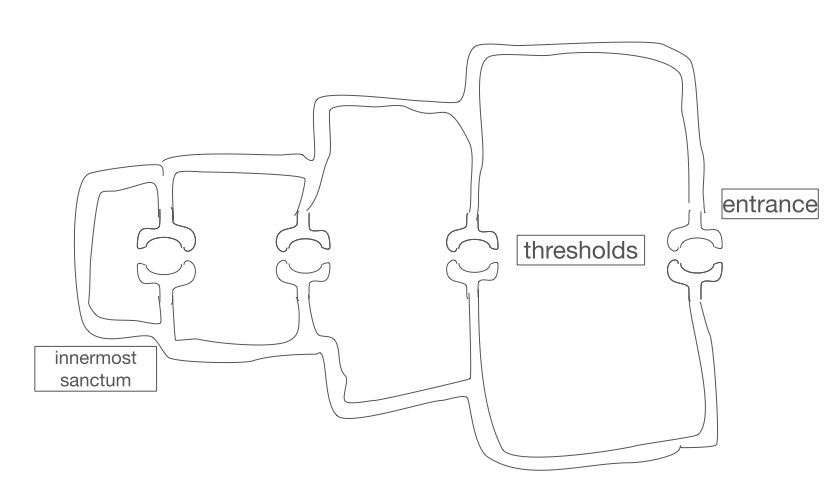
I describe two patterns here, one from the domain of the social, the other from the domain of the sacred. I discuss them together because they are of the same shape; the shape, or form, that they share is also shared with the human self.
Holy Ground
This is the visual form of the shape: [my drawing, adapting Christopher Alexander, A Pattern Language (1977), Pattern 66: Holy Ground (p. 334)]
Ask Tosomitu About House Elves
I’m going to interpret Daniel’s first question narrowly (or else we’ll be here all day), as “Is it more or less ethical to create a house elf, relative to a human?” where by ‘house elf’ I mean a conscious, sentient being of approximately human intelligence with a psychology built around an essential need to serve humans and the enjoyment of doing so. (See Harry Potter and the Chamber of Secrets.)
Variations on a theme: heroic protectiveness
Tiffany Aching has heroic protectiveness:
All witches are selfish, the Queen had said. But Tiffany’s Third Thoughts said: Then turn selfishness into a weapon! Make all things yours! Make other lives and dreams and hopes yours! Protect them! Save them! Bring them into the sheepfold! Walk the gale for them! Keep away the wolf! My dreams! My brother! My family! My land! My world! How dare you try to take these things, because they are mine!
Sometimes, there is danger in the world – the welfare of things and people beyond oneself is threatened. Depending on how globalized your society is, it could be a threat to a family, tribe, institution (like a school or large workplace), city, country, planet, or universe.
A hero is someone who:
- observes this threat, where others fail to notice it or ignore it;
- does their best to eliminate this threat, where others accept it or hope that someone else will eliminate it.
Continue reading “Variations on a theme: heroic protectiveness”
The NPOV Strikes Again
From Wikipedia (http://en.wikipedia.org/wiki/Planned_Parenthood):
Planned Parenthood receives about a third of its money in government grants and contracts (about $360 million in 2009). By law, federal funding cannot be allocated for abortions, but some opponents of abortion have argued that allocating money to Planned Parenthood for the provision of other medical services “frees up” funds to be re-allocated for abortion.
“Some opponents”.
As the saying goes, all money is green. In other words, money is fungible – a concept Wikipedia helpfully links to. If you give me a $10 bill and tell me not to spend it on booze, what are you really saying? That that particular serial-numbered bill should not be used in a liquor store? Okay, I’ll use the two fivers in my wallet for booze, and spend “your” $10 on the food I was eventually going to have to get anyway. And what about electronic money? Dreams about dreams.
Literally the ONLY constraint “no federal funds for abortions” puts on Planned Parenthood, is that the dollar sum of their non-abortion services must be greater than or equal to the dollar sum of federal Title X money received (assuming no other donors restrict where their dollars go). It obligates them to play a little accounting shell game, but in the counterfactual world where PP does not receive federal money, they almost certainly perform fewer abortions; thus, federal funding causes more abortions to occur.
(No comment implied on whether that is good or bad. It is certainly bad from the point of view of abortion opponents this provision is supposed to mollify.)
Ideological Agriculture, Preamble (An Excerpt From the Sermon of a Known Lunatic)
In this most exciting of times – as your god is reawakening, as the portents of conflict appear in the east and the west, at our cities’ edges and at their centers – it is increasingly vital for a true believer such as yourself to be prepared for the worst sort of situation. I’m speaking, of course, of those times you find yourself in dire need of your god’s intervention but without the necessary tools to request it.
It matters not how well you know the ritual, whether your altar is pristine, nor whether your knives and sconces are sharpened and lit – if you haven’t a good offering to bleed dry before the ever-watchful eyes of your divine master, your cries simply will not reach him. We know this, since it follows the oldest laws of humanity, passed down to us from the old ones in the most ancient times. We know that a thing of value must be destroyed when we commune with the divine; it allows us to open the otherwise sealed channel. And while we know this is inconvenient, we cannot help it; it is simply the way our world works. As such, as members of the devout we should never find ourselves without something of value on hand, should occasion for sacrifice arise.
Continue reading “Ideological Agriculture, Preamble (An Excerpt From the Sermon of a Known Lunatic)”
Science Journalism Marches On
The claim that bacteria in the human body outnumber human cells by an order of magnitude or so has become a popular observation among Science Fans. A 2008 article in the ghastly New York Times states:
The bacterial cells also outnumber human cells by 10 to 1, meaning that if cells could vote, people would be a minority in their own body.
This is misleading. A single bacterium masses something on the order of 10-13 – 10-12 grams, while a human body cell is in the neighborhood of 10-9g — 1,000 to 10,000 times larger. By weight, bacteria therefore compose somewhere between 1% and 0.1% of you, depending mainly on how recently you went to the restroom. Thus, the Important and Popular Fact presented in the NYT and other sources is technically true*, in the sense that Vin Diesel is outnumbered by a small bag of crickets.
*: The claim also skips over the fact that the largest fraction of the bacterial population in question consists of symbiotes, which could be designated honorary human cells under the mitochondrial grandfather clause, but that’s a whole other post.
Beauty is Fit
[E]very design problem begins with an effort to achieve fitness between two entities: the form in question and its context. The form is the solution to the problem; the context defines the problem. In other words, when we speak of design, the real object of discussion is not the form alone, but the ensemble comprising the form and its context. Good fit is a desired property of this ensemble which relates to some particular division of the ensemble into form and context.
There is a wide variety of ensembles which we can talk about like this. The biological ensemble made up of a natural organism and its physical environment is the most familiar: in this case we are used to describing the fit between the two as well-adaptedness. But the same kind of objective aptness is to be found in many other situations. The ensemble consisting of a suit and tie is a familiar case in point; one tie goes well with a certain suit, another goes less well. Again, the ensemble may be a game of chess, where at a certain stage of the game some moves are more appropriate than others because they fit the context of the previous moves more aptly. The ensemble may be a musical composition — musical phrases have to fit their contexts too: think of the perfect rightness when Mozart puts just this phrase at a certain point in a sonata. If the ensemble is a truckdriver plus a traffic sign, the graphic design of the sign must fit the demands made on it by the driver’s eye. An object like a kettle has to fit the context of its use, and the technical context of its production cycle. In the pursuit of urbanism, the ensemble which confronts us is the city and its habits. Here the human background which defines the need for new buildings, and the physical environment provided by the available sites, make a context for the form of the city’s growth. In an extreme case of this kind, we may even speak of a culture itself as an ensemble in which the various fashions and artifacts which develop are slowly fitted to the rest.
Christopher Alexander, Notes on the Synthesis of Form, pp. 15-16, Citations removed.
The problem with Old Ones is that you can’t second-guess them.
Formula for creating a perfect immortal being
i. The being must either decay at an absolute rate of 0% or it must take energy from its environment, use that energy to replicate at a rate that will not exceed that environment’s capacity.
ii. The being must be highly adaptive and resistant to external threats, resolving them either by coercion, co-option, or mimicry.
iii. The being must be even more highly adaptive and resistant to internal threats, and the result of any engagement must be the victory of whichever internal components optimize its survival.
iv. If for any reason there is a critical failure in stages i – iii, the being must be able to enter a state of dormancy until it is ready to make another attempt at permanent, active existence.
 Carcinisation